
Regardless of if we want them or not, we have to send in the clowns. But then that would make us feel better, right? The descendants of jesters traipsing around and pulling long strings of hankies out of their mouths for shits and giggles. They’re supposed to be funny—we expect them to be funny. But that’s why there’s almost nothing sadder than a clown who can’t be funny. It’s what W. Maxwell Prince and a variety of artists like Vanesa Del Rey, Zoe Thorogood, Roger Langridge, Patrick Horvath, Gabriel Hernández Walta, Martín Morazzo, and Chris O’Halloran show us across six issues of their anthology series, Haha.

Much like Prince, Morazzo, and O’Halloran’s series Ice Cream Man, Haha is six stand-alone stories all centering on a common theme: clowns. These clowns go through quite a bit. From the mother who uses clown make-up during manic episodes to connect with her daughter to the mime that finds a miming robot in a dump to an alcoholic birthday clown that gets sucked into one of his own balloons to an older clown reminiscing on her past in a traveling circus, with these stories bookended by two different ways a bullet can enter a clown’s head. None of these stories would go in ways that we expect, largely in part to them being about clowns, but also the ways in which the art plays with our expectations. The third issue, “Remi Says..” for instance, is much more stylized than the others in the series thus far. But the impact that comes from the titular mime being shot to death by police hits all the harder as a result.
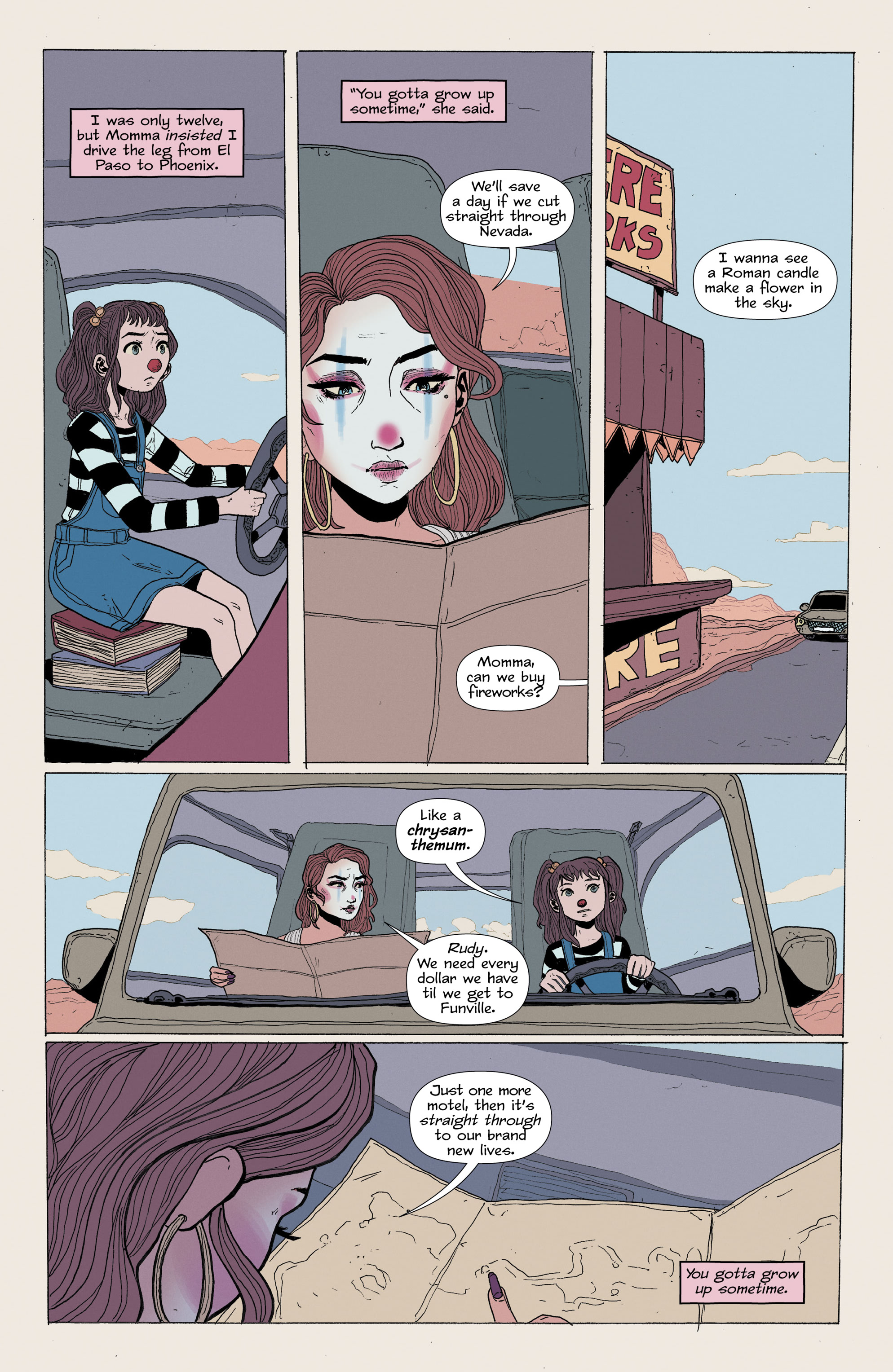
Despite being only six standalone stories, Haha is able to run the full range of the human experience through a rubber-nose-red-tinted lens. There is the inherent tragedy of existence that comes with being a clown—the first and last issues deal with that handily—but we also see the ways in which our parents play a role in how we grow up, the regrets that tie us down, and the bitter nostalgia for a long-gone past. It’s a testament to the creators that we’re able to connect so immediately with each of the clowns that we see—not just because they’re the center of attention, but because we can already see so much of our own tragedies reflected in their greasepaint.

Haha has moments that are going to stick with me long after the series finds a home in my long boxes. Pound Foolish looking forlornly at a sepia picture of her old circus mates already feels like looking back at my own old pictures. This is why clowns persist despite the movies and incidents that paint them as terrors—even when we’re scared of them, there is something hauntingly familiar in the eyes of a clown. It’s the eyes of someone else looking back at us and every story they have to tell.
Get excited. I am Pagliacci.

Drew Barth (Episode 331, 485, & 510) resides in Winter Park, FL. He received his MFA from the University of Central Florida.

 The Drunken Odyssey
Leave a comment