
While meta-narrative detective stories in which the titular character must find out who killed him in his own story can be interesting, I feel suspicious whenever this trope crops up. Peter Milligan, Raül Fernandez, Giada Marchisio, and Jeff Eckleberry’s first issue of Profane uses the trope to perfection.

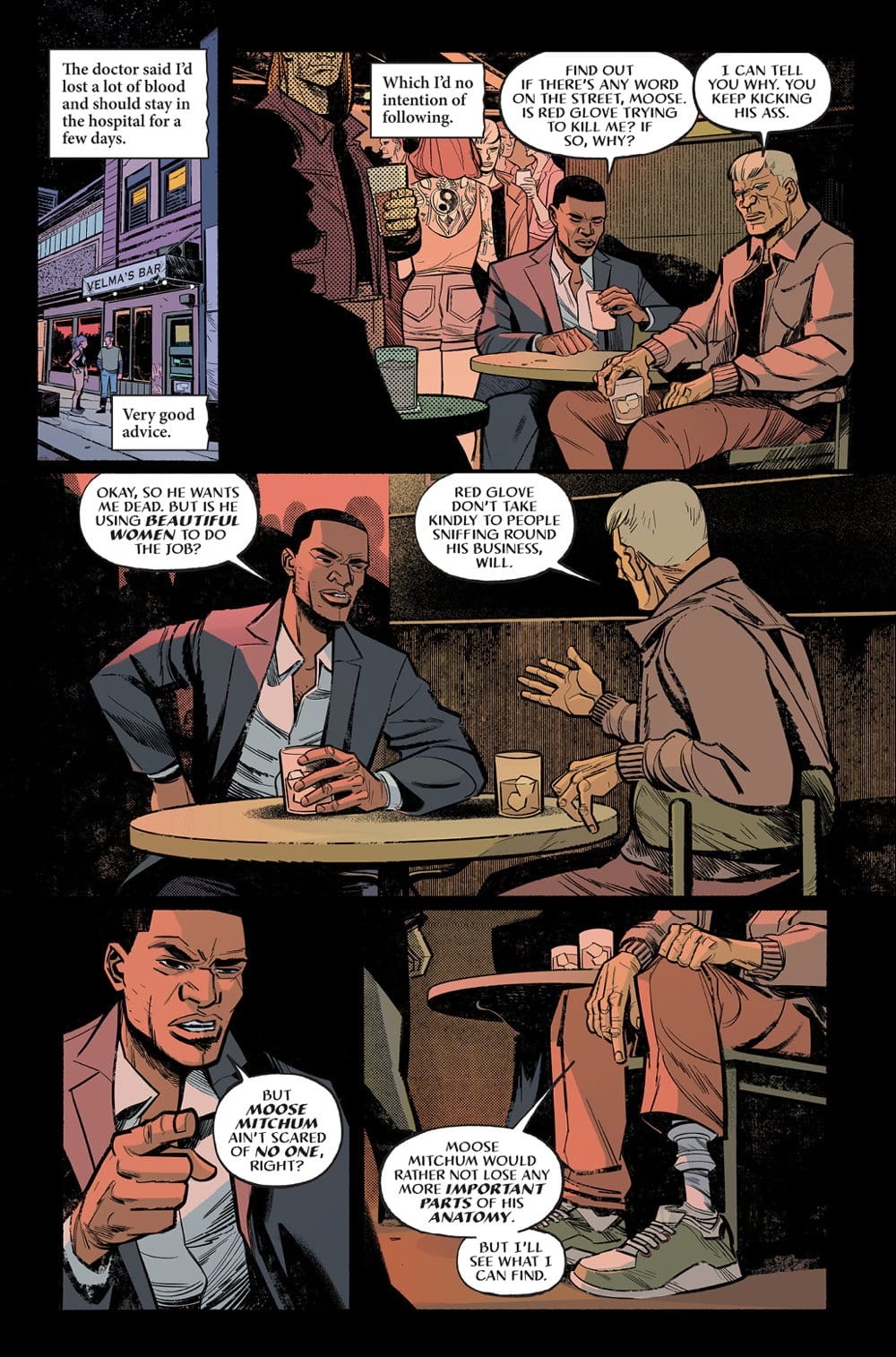
From the opening panel, Will Profane lays out who he is and what he’s trying to do: a private investigator with a case to solve. But we already have a twist by the second page as he approaches what is presumably the solution to the case before he blacks out and ends up in a bar. He talks of the case as though it were a recurring dream—the same details taking place over and over. But it’s through his memories and his usage of a particular scrying technique that he’s pointed in another direction toward someone who may know where this particular case is leading him. But she wants nothing to do with him after saying his name is Will Profane. Not for any past slights, but because that’s the name of the detective in her ex-boyfriend’s detective novels. And while Spud Coltrane may be a prolific author, the discovery of his recent murder as the site where Profane blacked out shows us his involvement in the mystery.

Milligan, Fernandez, Marchisio, and Eckleberry use our perception of detective stories to raise more existential questions for our detective, namely: if the author of the story is dead, what will the main character of the story do now? At a point, it feels almost redundant to respond “solve the murder” since that’s an afterthought here. Can a character independent of their writer actually exercise any real agency outside of what the story says? And when someone else has stolen the latter half of the manuscript, how does this character know if they’re acting within the original story or within the edits made by someone trying to lead them astray? We dive deeper and deeper into what is and isn’t considered free will within the confines of the story and how much of that may simply be a matter of perspective. And all within the first issue of a larger series.
Profane from the final page of this issue feels like it is here to reconfigure character in a detective story. We’ve seen so many mysteries over the centuries that finding a new way to explore what a detective can do in fiction feels like dozens of authors looking to squeeze blood from a stone. And yet here we’re still seeing the drips of blood coming from the genre in ways that both the readers and the characters trapped in the narrative couldn’t expect.
Get excited. Get spiraling.

Drew Barth (Episode 331, 485, & 510) resides in Winter Park, FL. He received his MFA from the University of Central Florida.

 The Drunken Odyssey
Leave a comment