
That was a nice interview last week, wasn’t it? But now we return to the ever diminishing pile that isn’t quite as diminishing as new comics are still being added to it. Even still, it dwindles like a snowman in February and we chip more away at it. This week’s focus is going to be on another shorter series from DC from a couple years ago that turns our attention to a legacy character, his daughter, and the lengths the latter will go to bring the former back to his prison cell in Crush & Lobo by Mariko Tamaki, Amancay Nahuelpan, Tamra Bonvillain, and Ariana Maher.

Crush & Lobo begins with a sort-of break-up and a need for self-reflection. Or, for Crush, she tries to do that second part. As the daughter of known murderer, bounty-hunter, and general menace, Lobo, it’s hard to suppress the need for some violence. But when said menace of a father reaches out from prison for a meeting, Crush decides to do some emotional repression and visit her old man instead of thinking about her girlfriend. The downside of being one of the two last living members of a species, though, means that it isn’t difficult for Lobo to transfer his biometric prison tracker to her and escape while she gets stuck in his prison cell. After discovering the swap, the warden gives Crush 50 hours to bring Lobo back or else the timer on her wrist will immolate her.
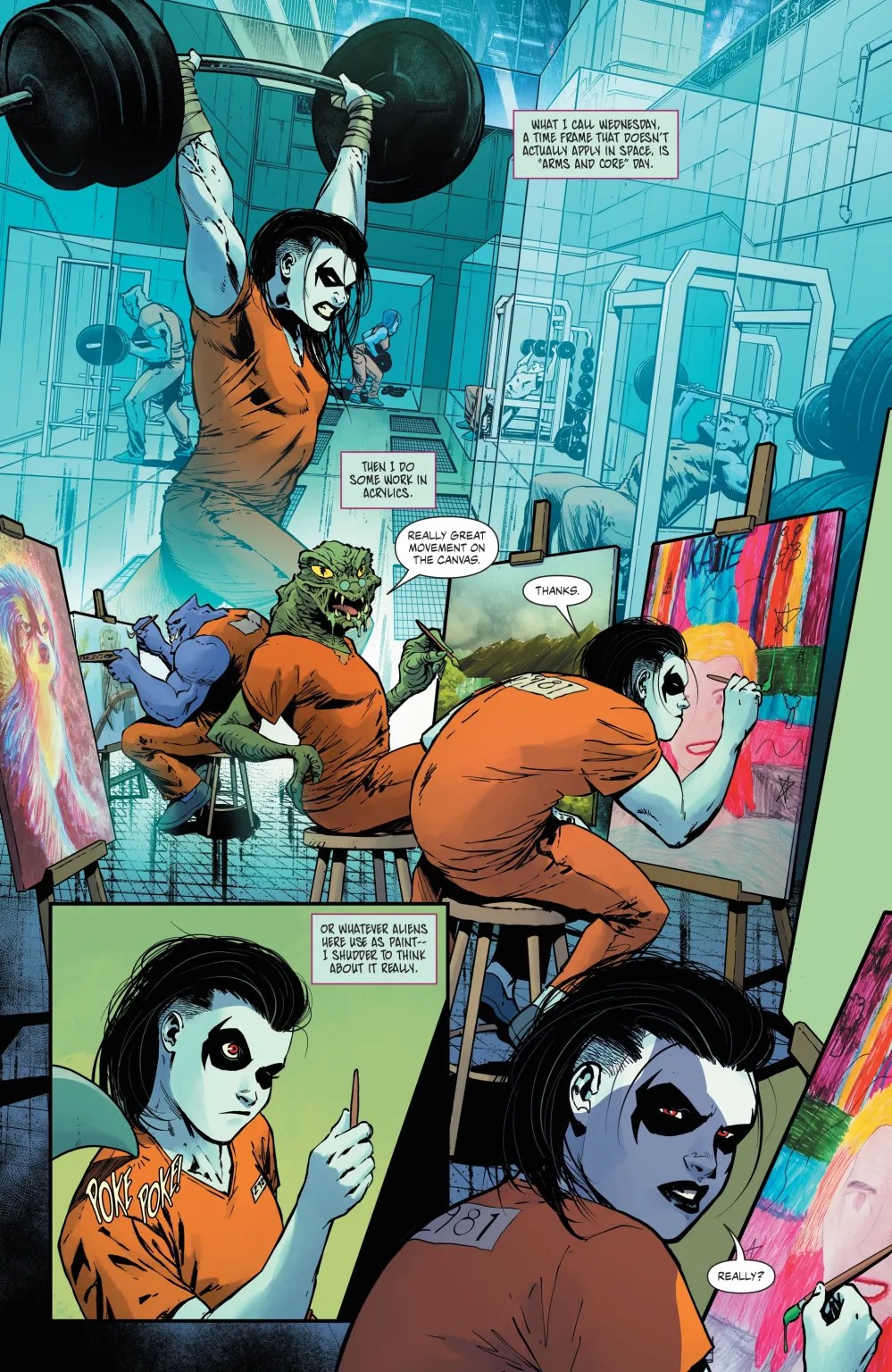
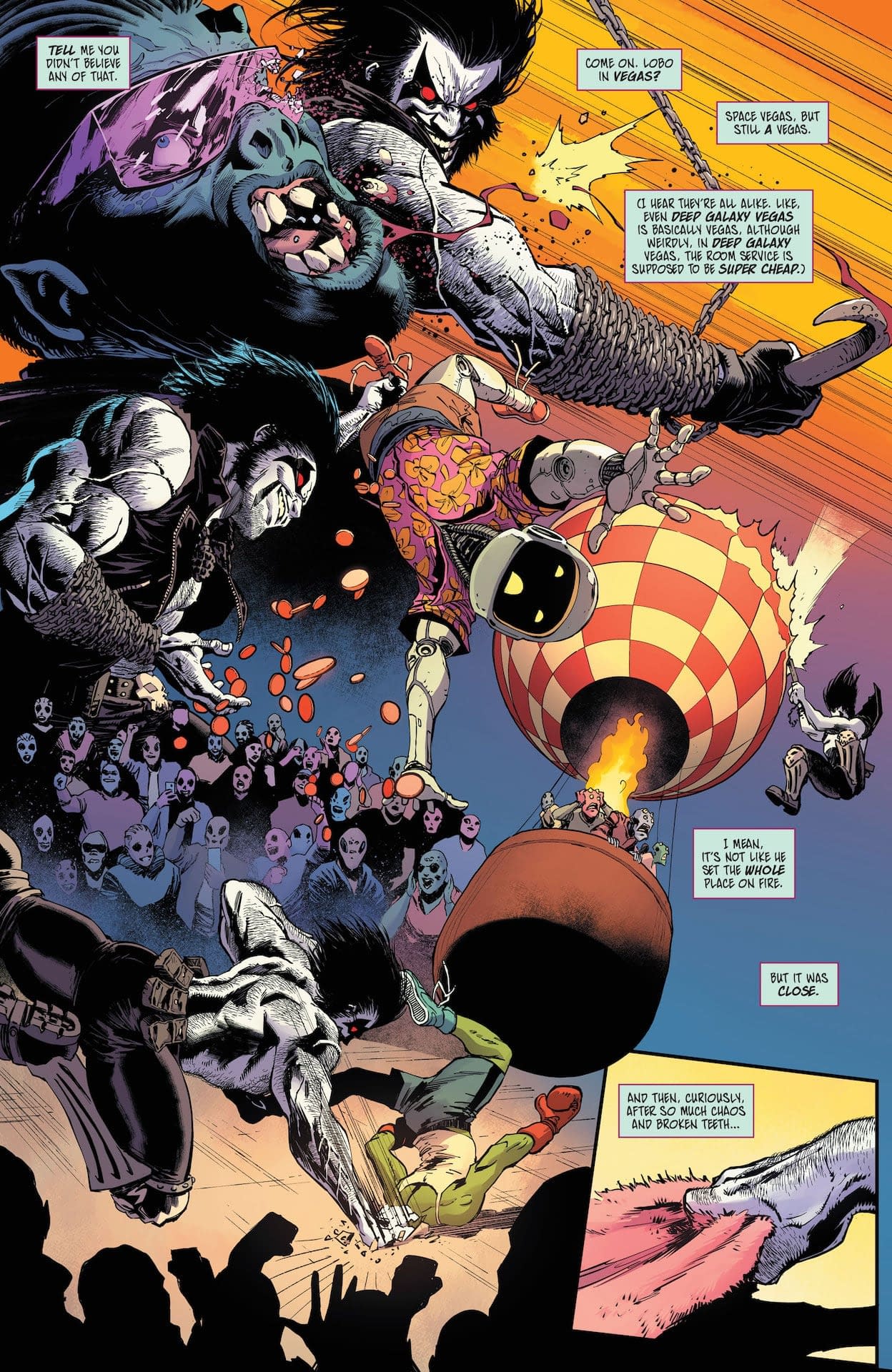
It is interesting to see a series work with a character like Lobo in a way that hasn’t quite been done before. Much of his appearances since Keith Giffen, Alan Grant, and Simon Bisley’s series in the early 90s has been as this chaotic bounty hunter—either with our focus on his violence as a general good or him as a general villain/comedic piece for other characters. Here, we get a more zoomed-out perspective as we see that this isn’t just zany violence, it’s active harm to his daughter. In this way, we’re seeing the team here satirize the satire. If Lobo is the demonstrated extreme of violent tendencies in comics in the 80s and 90s, then how does he look from outside his own context? What is he when not the star? As a being of almost pure id, we see what he is fully: selfish, ego maniacal, murderous. Crush, by contrast, can feel these aspects but actively rebels against them and shows us Lobo outside that nostalgic, fanboy lens. In this way, both Crush and the audience have to accept what Lobo is to move beyond what we think he should be.
For Tamaki, Nahuelpan, Bonvillain, and Maher, Crush & Lobo is how we can better look at legacy characters and their contemporary counterparts. We can take them apart and see them for what they’re meant to be without having to explicitly say that one is better than the other. We can explore their relationships, what makes them tick, and how they can lean on one another to make that much of a better story.
Get excited. Get crushed.
Drew Barth (Episode 331, 485, & 510) resides in Winter Park, FL. He received his MFA from the University of Central Florida.

 The Drunken Odyssey
Leave a comment