

with Dmetri Kakmi
I Married a Monster From Outer Space
USA, 1958
Director: Gene Fowler Jnr
Cast: Tom Tryon, Gloria Talbott, Ty Hardin, Peter Baldwin
I hear you, Gloria!
You marry hunky Tom Tryon and you wake up one morning going, ‘Oy, vey, what have I done to deserve this? He doesn’t sleep with me, but he hangs out at the park at night, meeting strange men. What gives?’
Metaphors don’t get more potent than I Married a Monster From Outer Space. Nor do movie titles get more screamingly sensational. One wonders what sort of reception this surprisingly smart film might have had if it had been called something sensible, like A Lifetime of Compromise or Unspoken Vows.
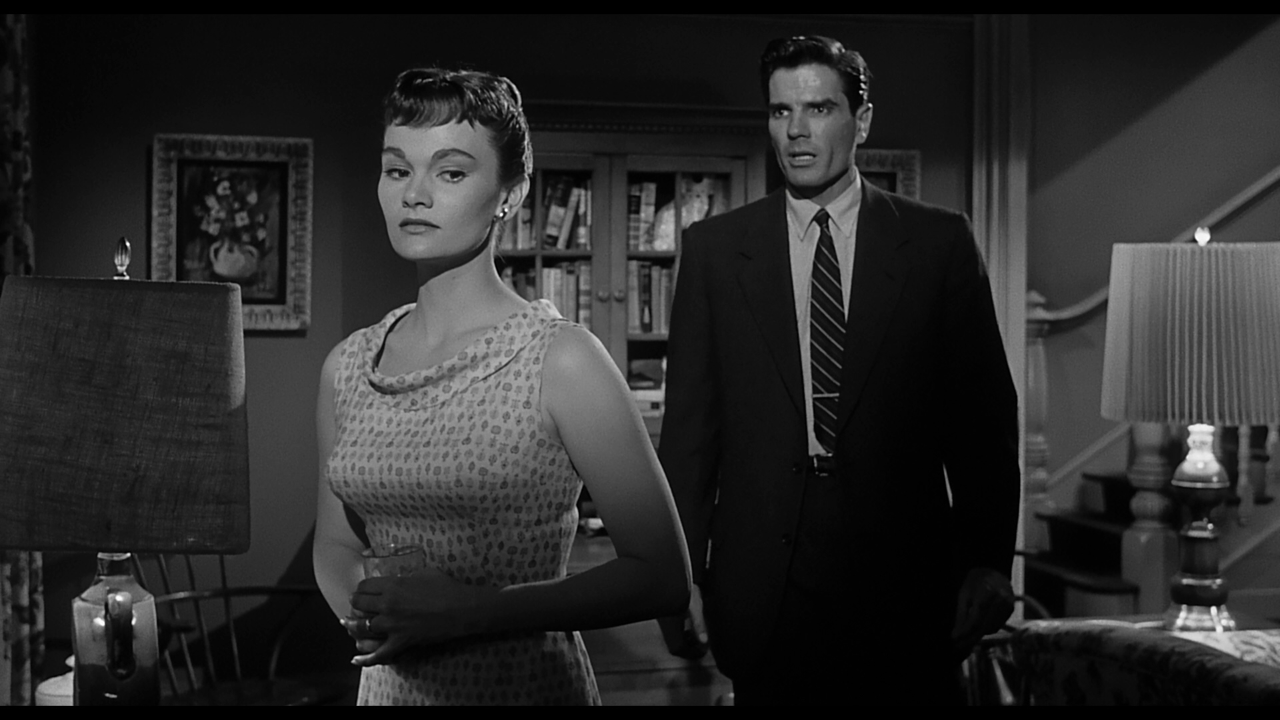
First, it would not have been on a drive-in double bill after The Blob (1958). Second, critics would have taken the film more seriously. You can bet on that because if you watch this gem you will be surprised by its astutely played-out scenes between husband and wife, the low-key acting, and a social realist approach to pictorial depictions of stifling conformity, marital and sexual anxiety, and herd-like mentality.
The title sums up every newly weds’ apprehensions about the person they married and the unseen substrata of the human totality with which they must share a bed, supposedly for life. After a whirlwind courtship and fairy tale wedding comes an awakening that, more often than not, does not match the flimflam of romance novels.
Director Fowler goes to great lengths to depict the sinister aspects of suburbia and the cliquish behaviour of newly weds congregating to procreate in secluded enclaves occupied by others like them. Into this mix the script drops in the notion of the male spouse as the “alien” or “unknown other”, who reveals himself by degrees, tentacles and all, leaving the wife to question who she married.
Marge decides her marriage is worth fighting for and it’s in bravely undertaking the quest that she blithely sails into the film’s next big revelation. Behind procreational heterosexuality lies another world—namely a hidden homosexual realm that may thwart the nuclear family.
You really sit up and take notice when this underlying theme kicks in because suddenly you are going, “Is this film saying what I think it’s saying?” Indeed, Homeros, to use film critic Parker Tyler’s reference to homosexuality in cinema, does rise his head.
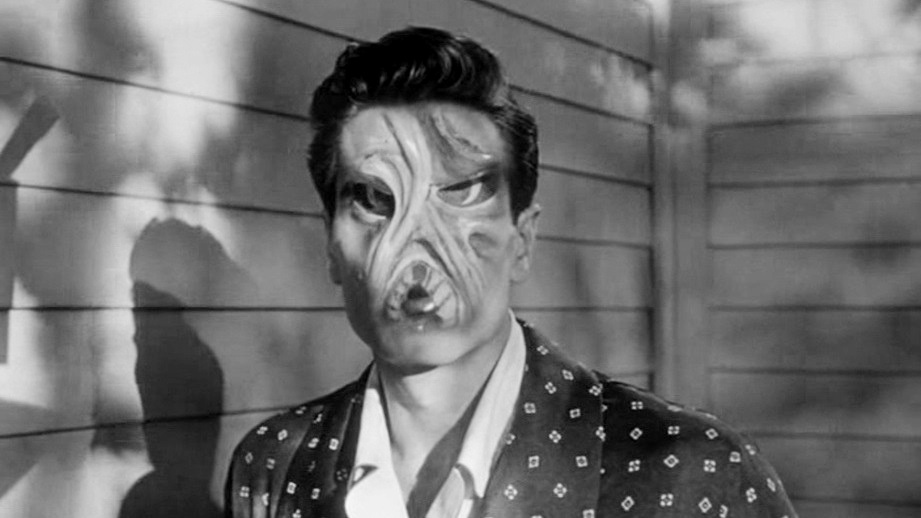
The film’s opening gambit shows Tom Tryon as Bill driving to a buck’s party before he marries Gloria Talbott’s Marge Bradley. In a lonely spot in the woods, Bill is accosted by a glowing humanoid that possesses his strong, buff, sexually desirable—okay, I’ll stop, but you get my meaning—body. Marge unknowingly ties the knot not with swoon-worthy Bill but an alien who came to Earth to mate with human women because females on his planet died—probably because they had a heart attack when they saw what their menfolk look like.
Settling into the marriage, Marge discovers that Bill is acting “strangely”. He is not the man she thought she married. He has peculiar habits. Worse, he won’t share a bed with her and their love life is kaput. When offspring fail to materialise Marge consults her doctor. He assures her it’s not her; it’s Bill. One night she follows her glowering darling to a nearby woods where he meets other men who are similarly “afflicted”. To Marge’s astonishment the men enter a space ship and she is burdened with the unenviable task of informing local authorities of an imminent invasion.
A slight diversion here to point out what “spaceships” in parklands might mean to homosexual men. In the bad old days when heterosexuals went out of their way to kill homosexual men, the only place for gay men to meet were public toilets. Once inside, these public conveniences became a kind of flying saucer that transported same-sex attracted men to a fantasy land, where sex with other men was possible and free of harassment. So when we see Bill enter a spaceship with a group of strange men in the middle of the night, we know precisely what the film alludes to.
With his Chesty Bond physique, Tom Tryon was almost a parody of 1950s ideal manhood. His sexual ambiguity is always apparent, the actor displaying deep emotion under a calm exterior. Tryon was closeted for much of his film career. He came out in the 1970s when he became a successful novelist, publishing successful literary horror, like The Other and Harvest Home. Watching the film, I wondered if the filmmakers were aware of his sexuality when he was cast. The strong undercurrent towards reading it as a metaphorabout hiding as a gay man in an arranged marriage feels acute even when you don’t know what went on in Tryon’s real life.
Another scene where Homeros makes an appearance is when similarly replaced neighbour Sam visits Bill, ostensibly over an insurance policy, where Sam must reveal himself with an overt gesture when Bill won’t get the hint, whereupon Bill welcomes him into the exclusive all-male club. It’s a scene that feels like an elaborate form of gay men signalling to one another through the kind of arcane gesture and language they used in the early parts of the twentieth century, and possibly still do in countries where homosexuality is illegal.
Not for nothing, then, do the town’s “breeders” hunt down the misfits who cannot reproduce. Even when the alien influence is broken and the “cured” men return to their respective wives, a question mark still hangs over their collective heads.
Dmetri Kakmi is the author of The Dictionary of a Gadfly (as The Sozzled Scribbler), The Door and Other Uncanny Tales, Mother Land, and When We Were Young (as editor). His dark fantasy novel, The Woman in the Well, will be published in April 2025. He is working on a crime novel called The Perfect Room.

 The Drunken Odyssey
Leave a comment