
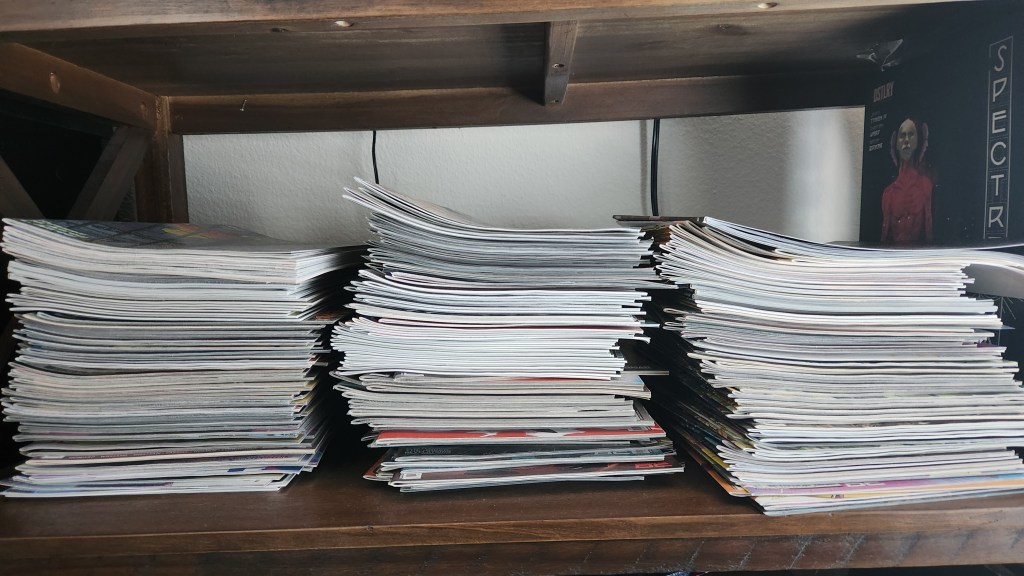
And so we return to the pile. And we also return to a series I’ve written about multiple times in the past, but one I can’t stop going back to as the entire structure of it has been fascinating. We see in a series like Christopher Cantwell, Alex Lins, Luis NCT, and Mar Silvestre’s Briar that we can expand on how we approach long-term storytelling in comics and what that can mean for the overall process of getting that comic out to the world.

When we had last left Briar Rose, things were grim. While her band of friends had expanded with the resurrection of the legendary Captain Bly—or at least his skeleton—they had failed to stop Briar Rose’s godmother and had resorted to doing odd jobs just to get by while they planned their next move. But they’ve been branded as criminals and murders and the local constable accosts them into violence, leaving a village girl dead. As is customary with any act two of a story, things only get worse as Briar Rose and Spider are jailed on a remote island, Captain Bly is disassembled and buried in holy ground, and their wytch, Roop, is pressed into farm labor by the constable and his wife. It’s a lot of low points for a four issue arc. But with the help of cranes that roost on the prison’s island, the group is able to reunite, despite still being destitute.

For Briar as a series, though, one of the more interesting things has been the way in which the series has been published. Starting out as a four-issue miniseries before being expanded out further into another four issues and then the recent announcement of the series’s final arc a year after this most recent arc’s conclusion shows us a different approach to putting out comic stories. As a medium, monthly comics is tough. Scripts into art into inks into colors into lettering and all the passes in between those steps to ensure things are solid create a crunch that’s hard to maintain for long. What Briar ends up doing so well in this regard is that break time in between the major arcs. Everyone on the creative team can take time to recover before jumping back into the series. This has lead to a series that has been given some breathing room to find where it needs to go with its next arc without that monthly schedule breathing down its neck.

Visual narratives in general do have grueling schedules, be it western’s comics monthlies or the weekly schedule of manga, burnout is something we hear about continually. But we’re seeing over the past few years how this can be mitigated with different strategies for publishing or just different schedules for creators to ensure their health and safety is prioritized. It doesn’t just keep the people in the medium healthy, it keeps the scene thriving since rested minds create much better art.
Get excited. Get a break.
Drew Barth (Episode 331, 485, 510, 651, & 674) resides in Winter Park, FL. He received his MFA from the University of Central Florida.

 The Drunken Odyssey
Leave a comment