

with Dmetri Kakmi
Repulsion
England 1965
Director: Roman Polanski
Cast: Catherine Deneuve, Ian Hendry, Yvonne Furneaux, John Fraser
Roman Polanski’s first English-language film uses the labyrinthine symbolism of cracks and fissures to explore the mind of a deranged woman and, perhaps unconsciously, reaffirm Woman’s pagan association with Earth.
When it gets going, Repulsion is full of cracks and fissures, literal and metaphoric.
“Crack”. An intriguing word that literally sounds like it’s meaning. A sharp, sudden explosive sound, a split between two surfaces which have broken or moved apart. Even the synonyms are revealing: split, rupture, fracture, slit, to name a few.
Cracks can connote real cracks in walls and pavements and a state of mind. A “cracked” person is unstable as their world begins to fall apart. A crack can be an arse crack and the enticing cleft between a woman’s legs, the gateway to her inmost depths. For the TikTok generation, “getting cracked” is to have sexual intercourse. If something is “totally cracked” it means it got out of hand and became chaotic.
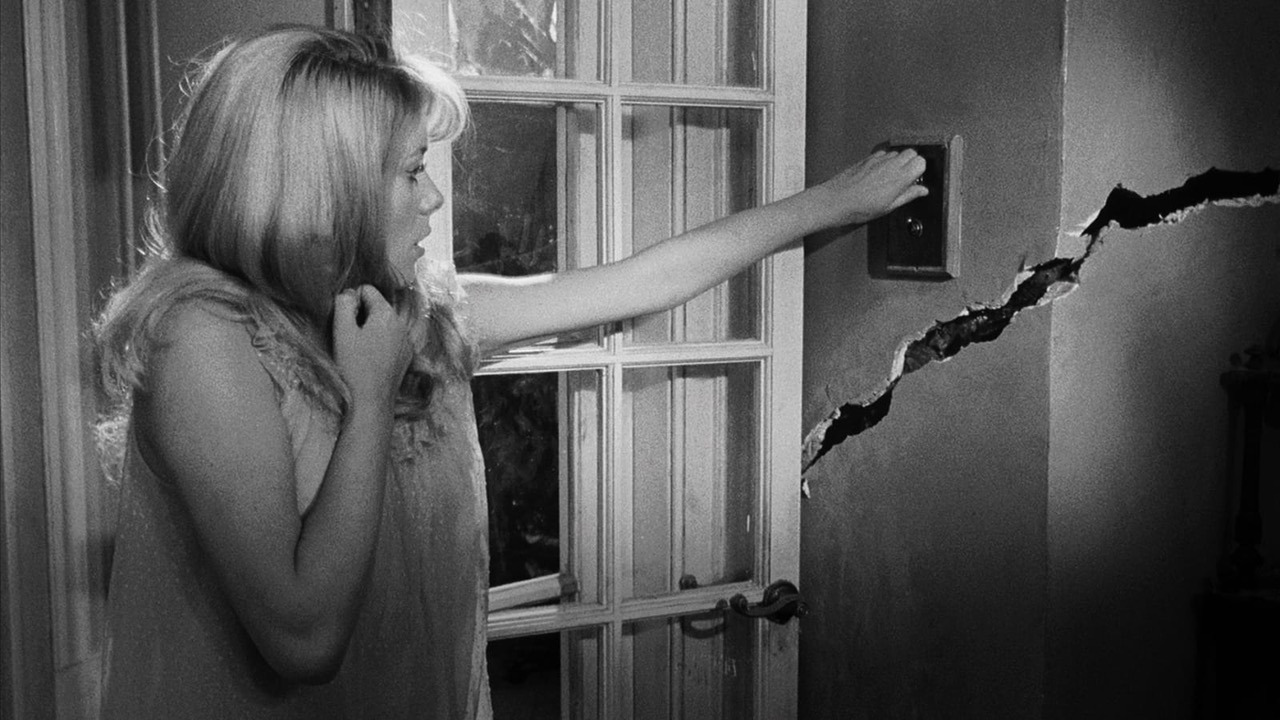
As you expect from Polanski, all of the above come into morbid play as Catherine Deneuve’s Carol Ledoux begins to lose her grip on reality in the face of unwanted sexual attention.
A fissure, on the other hand, is a long, narrow opening, or a breakage made by a split in earth or rock. Relevant for Carol’s tenuous mental state, a fissure can also be a break in the spaces separating convolutions of the brain. When Carol’s inner state becomes external reality and vice versa, she cracks up under pressure and lashes out, subconsciously aligning herself with allegorical woman.
In Greek myth, female deities were said to reside in caves, grottoes and cracks in the earth. On Tenedos, the Aegean island where I was born, the princess Hemithea retreats to a cave after Achilles rapes her and she becomes the goddess who sleeps in the hill. In some versions of the story, Hemithea runs away from Achilles and is swallowed up in a chasm.
Islanders know that if you chance upon a crack in the dry earth while walking in the countryside, you either walk around it or offer propitiatory words of appeasement before stepping over it. Why? Because the crack is the goddess’s vulva. A woman can get pregnant if she walks over it without prior acknowledgment—a disaster if the child is deemed illegitimate. A man is swallowed up and not seen again, which is what happens to the men who hit on Carol Ledoux.
The men make clumsy attempts at coercive seduction, Carol, who fears the opposite sex, kills them and stores the corpses in her seedy London flat. Carol’s repulsion of men literally stems the flow of seminal fluids as she begins to crack up under the pressure of regenerated trauma. At the end, a lingering shot of a family photo suggests that young Carol was possibly molested by her father.
The fact that Polanski uses a 23 year-old Catherine Deneuve, then at the height of her fame and beauty, to represent the dichotomy of a femme fatale is smart casting. He is saying be careful, she’s not all she’s cracked up to be. She is both enticement and annihilation.
For all that, Carol is no mere caricature of a vagina dentata. She is also victim of a system that reduces women to sexual playthings for callous men and leaves them no option but to retaliate. Polanski triumph is in using sophisticated mise en scène that collapses the nexus between reality and fantasy and takes us to the darkest recesses of an unsettled mind and elicit pity.
Dmetri Kakmi is the author of The Woman in the Well, The Door and Other Uncanny Tales, Mother Land, and When We Were Young (as editor). He is currently working on a crime novel called The Perfect Room.

 The Drunken Odyssey
Leave a comment