

with your host, Dmetri Kakmi
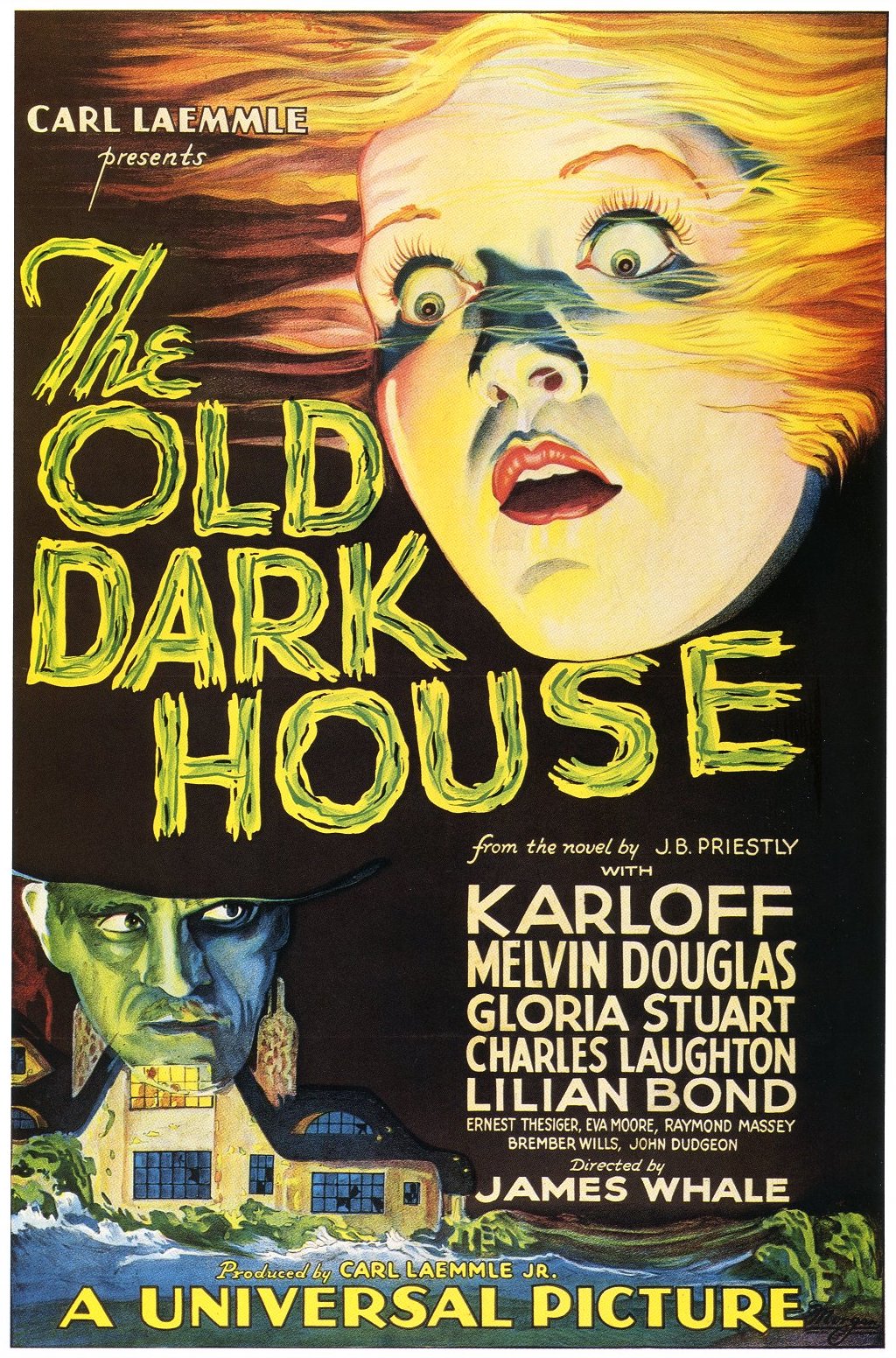
The Old Dark House
1932, USA
Director: James Whale
Cast: Ernest Thiseger, Gloria Stuart, Boris Karloff, Charles Laughton
It is hard to know where the horror film would be without gay filmmakers. Perhaps not surprisingly, homosexual men have found a home in the codified language of horror, opening new doors, founding surprising identification points, and pushing thematic and aesthetic boundaries.
A certain camp sensibility is intrinsic to horror comedy. But perhaps we need to define what we mean by ‘camp’; it is after all an old-fashioned term. ‘Camp’ is defined in the dictionary as ‘deliberately exaggerated and theatrical; extravagantly artificial, playful, flamboyant and affected.’
The definition can be applied to Argento’s Suspiria (1977) and De Palma’s Raising Caine (1992), two very over-the-top horror films that are not devoid of humour. We must also admit there is something intrinsically camp about serious horror cinema. Think of all the running around and screaming; the horrific collapse of facades, the shock revelations, the ostentatious deaths, that are part and parcel of the genre. You could be at a birthday party with The Boys in the Band, that classic of 1970s gay cinema. Even Gale Sondegaard’s Miss Lu, the fabulously sinister housekeeper in The Cat and the Canary (1939), owes as much to the drag performer’s talent for amplification as it does to the actress’s expert command of her art.
To my mind, there is no greater horror comedy than The Old Dark House. It is my favourite of the Universal horror movies; it never ceases to delight and surprise, no matter how many times I see it. And there is no greater horror movie director than James Whale (1889-1957).
British born Whale was openly gay and he found an outlet for his sensibilities in the handful of horror films he directed for Universal, bringing to them a visual splendour and anarchic humour that is rare. Whales’s Frankenstein (1931) is not funny, though it contains perhaps unintentional comic elements, thanks to Colin Clive’s wild-eyed Dr Henry Frankenstein. The Invisible Man (1933) is funny because Una O’Connor screams her head off at the slightest provocation, and Claude Rains turns in a deliberately hysterical turn as the unseen megalomaniac, erupting into maniacal laughter as he terrorises an English village, sans-culottes.
But The Old Dark House is the queen of them all. How else to describe this joyful masterpiece when the wonderfully waspish Ernest Thesiger descends the stairs and announces himself? ‘My name is Femm. Horace Femm.’ Horace then proceeds to live up to the patronymic of his gender-bending family, the likes of which have to be seen to be believed. We must wait decades before such freakish relations appear on screen in Texas Chainsaw Massacre, Daughters of Darkness and Snowtown.
Based on J B Priestley’s novel The Benighted, The Old Dark House pits five storm-stranded city slickers against Whale’s satire of the British family, all of whose members can be seen as gay, lesbian, bisexual or transexual.
These range from the aforementioned Horace Femm, to his religious fanatic, possibly repressed lesbian, sister Rebecca Femm, to the bedridden paterfamilias Sir Roderick Femm, who is unsettlingly played by Scottish actress Elspeth Dudgeon. Watching her brief appearance is akin to suddenly finding yourself in an uncanny valley; the eye and the mind do not quite connect as you struggle to make sense of what you are seeing. Also memorable are the cackling pyromaniac Saul and the mumbling homicidal butler Morgan (Boris Karloff), who shows surprising affection towards the dying Saul.
The sequence in which Rebecca Femm berates vain flibbertigibbet Margaret Waverton (Gloria Stuart) about the sins of the flesh is an astonishing display of acting and cinema craft. Played out with a combination of gusto and restraint in front of a mirror that distort the two actresses’ faces, it is by turns comic, disturbing and oddly sexual.
The Old Dark House is the blueprint for every haunted house and stalk-and-slash film that follows its illustrious footsteps. It is a visual delight, atmospherically lit and framed for maximum effect in brilliant black and white. It is archetypal and parodic, simultaneously setting up genre conventions and pulling them apart. Thought lost for almost forty years, it is now beautifully restored and available where good screams can be found.
Dmetri Kakmi is the author of The Dictionary of a Gadfly (as The Sozzled Scribbler), The Door and Other Uncanny Tales, Mother Land, and When We Were Young (as editor). His gothic novel The Woman in the Well will be published in 2025. He is currently working on a psychological crime novel called The Perfect Room.

 The Drunken Odyssey
Leave a comment