
with Dmetri Kakmi
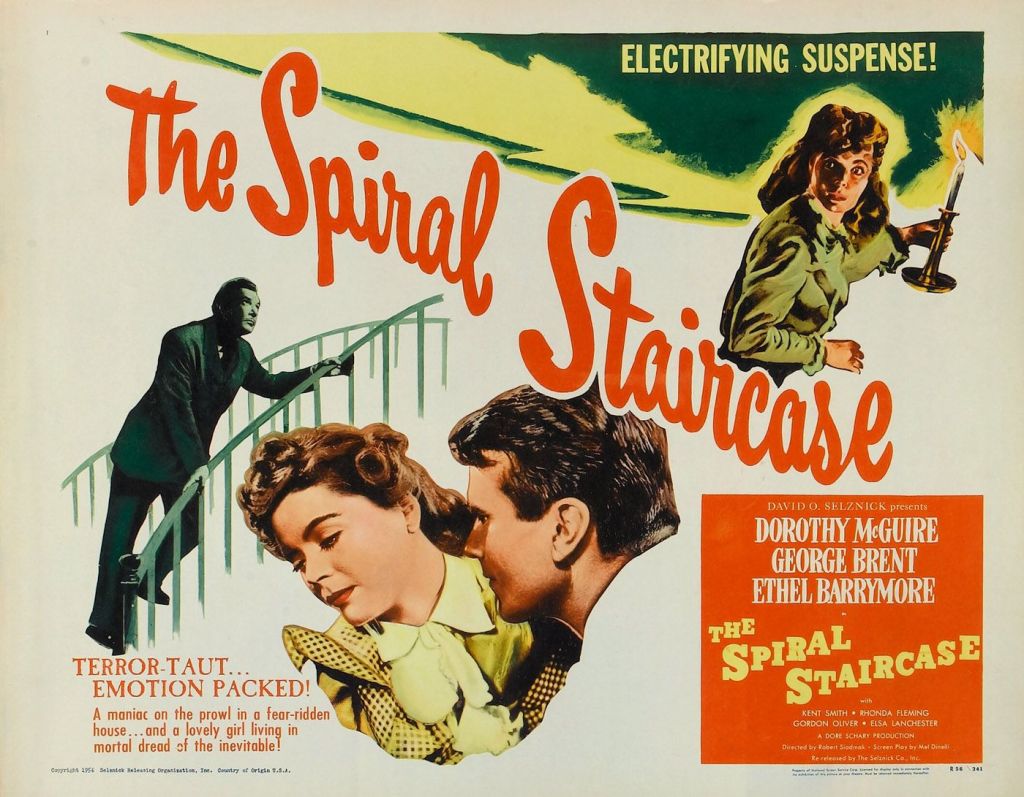
The Spiral Staircase
USA, 1945
Director: Robert Siodmak
Cast: Dorothy McGuire, George Brent, Ethel Barrymore, Kent Smith
The Spiral Staircase appears on this list largely because it may well be the first ‘slasher film’. Though tame by today’s standards, it stands out because of intelligent crafting and, as we shall see, the influence it had on Italian giallo cinema and Hollywood’s psychological thrillers.
The plot — a mute woman is stalked in a rural mansion by a serial killer whose murderous tendencies are aroused by women with physical disabilities — is standard fare. What counts is what director Robert Siodmak and cinematographer Nicholas Musuraca do with Mel Dinelli’s screenplay.
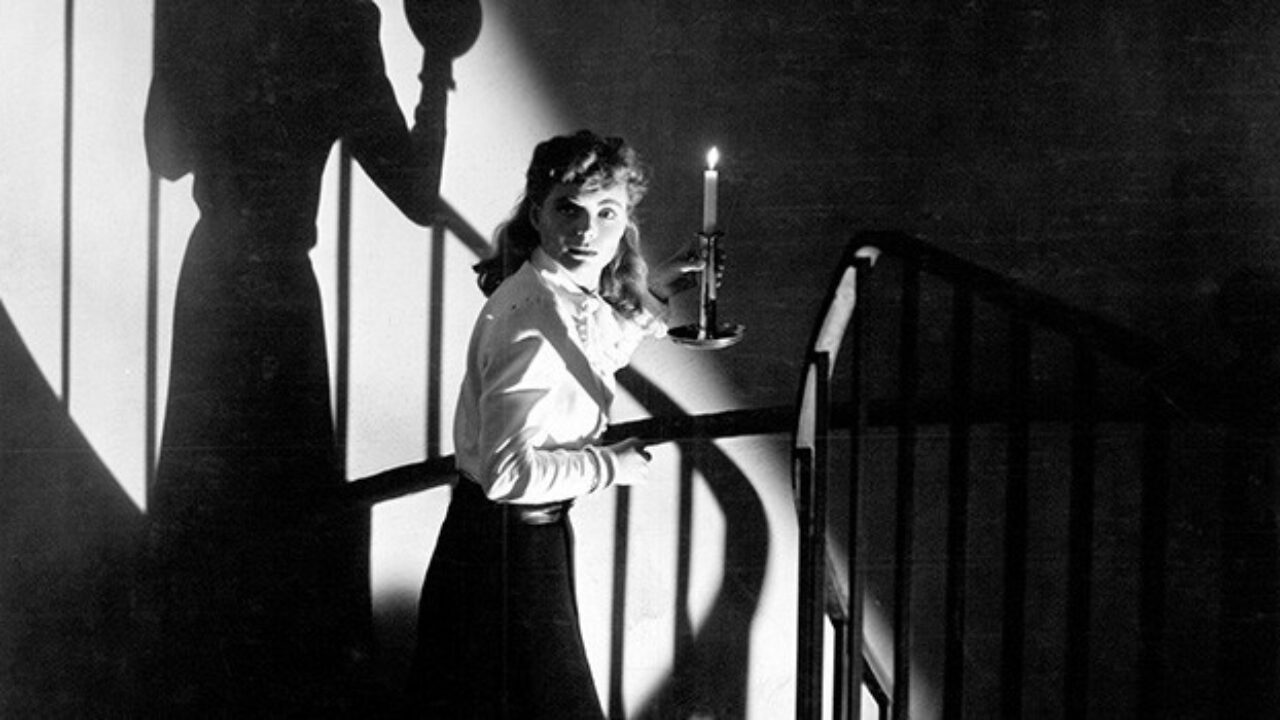
Cinema has always been about sitting in the dark and watching. In this state, the audience can project any fantasy it likes on an actor; it can engage in acts of heated love or savage murder, without feeling guilty. It is a harmless fantasy, a projection. The audience has after all paid for the privilege and the actor put him or her self on public display for the purpose. Anything can happen in this lawless, amoral space and it usually does.
Greeks, who have a word for everything, call it scopophilia — ‘skopein’, to look at, combined with ‘philia’, fondness or love for a specific thing. Thus we have scopophilia, sexual pleasure derived from watching others when they are naked or engaged in sexual activity. In other words, voyeurism.
And cinema is the most voyeuristic of all art forms.
The setting is a Vermont village in 1906. While an audience is enraptured by a silent film at a local inn, upstairs a woman with a limp is killed by a maniac. In a shot reminiscent of Dziga Vertov’s Man with a Movie Camera (1929), the murderer’s presence is announced in the woman’s room by a close-up of an eye, peering in a frenzy from inside the closet. The camera zooms in on the eye and performs a kind of inversion, allowing the audience to see what the killer sees. A vulnerable young woman in undergarments. The killer strikes as she pulls her dress over head, temporarily blinding her to impending danger. All we see is hands clawing the air in her final desperate moments.
This opening sequence announces Siodmak’s preoccupations. The film is an homage to silent cinema and cinematic watching. We, the audience, watch the screen as intensely as the killer watches his prey. We too take pleasure in seeing private acts as they unfold before our eyes, as much as the killer is aroused by his own obsessive preoccupations.
The principle tenet of silent movie — actors do not speak; when they open their mouths nothing comes out but silence — is extended to Siodmak’s heroine. Helen is mute and she is downstairs, watching a film in which the actors, like her, do not speak, while a lame woman is killed right over head (she hears the thump of the falling body), and because of her own disability Helen is next.
One of the film’s pleasures is McGuire’s largely silent performance. She relies on body language and facial expression to convey thought and emotion. Like the heroin in Mike Flanagan’s Hush (2016), she cannot call for help. When the killer spies on her, he sees a woman without a mouth, a weakness and an imperfection that must be annihilated. McGuire is so riveting here that she almost knocks Ethel Barrymore off the perch as the bedridden invalid who knows more than she lets on. Interestingly, Barrymore won Best Supporting Actress for her role; McGuire did not get a look-in.
If the set-up for the lame woman’s killing sounds familiar, it’s because Dario Argento uses the idea in Tenebrae(1982). Except, of course, Argento is more explicit in the way he dispatches his lesbian victim in Grand Guignol fashion. The influence extends to the killer’s wardrobe. At one point, the madman in The Spiral Staircase wears a shiny rain slicker, gloves and hat, which’s we all know is every fashion conscious serial killer’s choice wardrobe in giallo films. I leave it to you to spot the ideas Brian de Palma uses to great effect in Dressed to Kill (1980).
As a horror movie aficionado I am intrigued by the way certain directors are identified with the films they make. Sometimes it’s a deliberate marketing choice (Hitchcock) and other times it’s unconscious or merely expedient. In order to conceal the killer’s identity, Nicholas Musuraca shot Siodmak’s eyes for the close-ups of the killer watching his prey. Decades later, Argento will shoot his own gloved hand holding the serrated knife that kills the many hapless women that are slaughtered in his own films. In 2006 Brian De Palma will use his own voice in The Black Dahlia’s notorious auditioning sequence. Whatever the case may be, it opens up interesting questions about a director’s own personal compulsions playing out on the screen.
Siodmak was obviously influenced by German Expressionist cinema. As is evident from his body of work in the 1940s, he was drawn to crime stories and thrillers. His greatest mark was made in film noir, such as The Killers (1946). The Spiral Staircase gave him the opportunity to construct elaborate suspense sequences that are master-classes in lighting, editing, mise en scène and camera movement. The result is his most beautiful film.
Dmetri Kakmi is the author of The Dictionary of a Gadfly (as The Sozzled Scribbler), The Door and Other Uncanny Tales, Mother Land, and When We Were Young (as editor). His gothic horror novel, The Woman in the Well, will be published in March 2025. He is now working on a crime novel called The Perfect Room.

 The Drunken Odyssey
Leave a comment