

with Dmetri Kakmi
Creature from the Black Lagoon
USA, 1954
Director: Jack Arnold
Cast: Julie Adams, Richard Carlson, Richard Denning and Ricou Browning as Gill Man.
Better known in my household as Creature from the Black Latrine, this month’s creature feature requires the admission of an unusual coming-out story.
I was sixteen years old when I saw Jack Arnold’s sci-fi horror classic on late-night television. Bad print, no 3D, ads. Even so, the minute my testosterone-soaked teenage eye spied Gill Man I knew I was a goner, as Australians say. Finding him terribly sexy in his tight rubber suit, I decided he was the love of my life.
‘I must be gay,’ I thought in my confused little brain. ‘I’ve fallen in love with a monster.’
From that day on, when my classmates expressed their lust for Farah Fawcett Majors, then at the height of her fame in the TV series Charlie’s Angels, I fantasised about Gill Man dragging me off to his love shack and pawing my supine form with scaly claws. Years later, when I found a picture of Ricou Browning, the man inside the suit for the underwater sequences, I knew I had made the right choice.
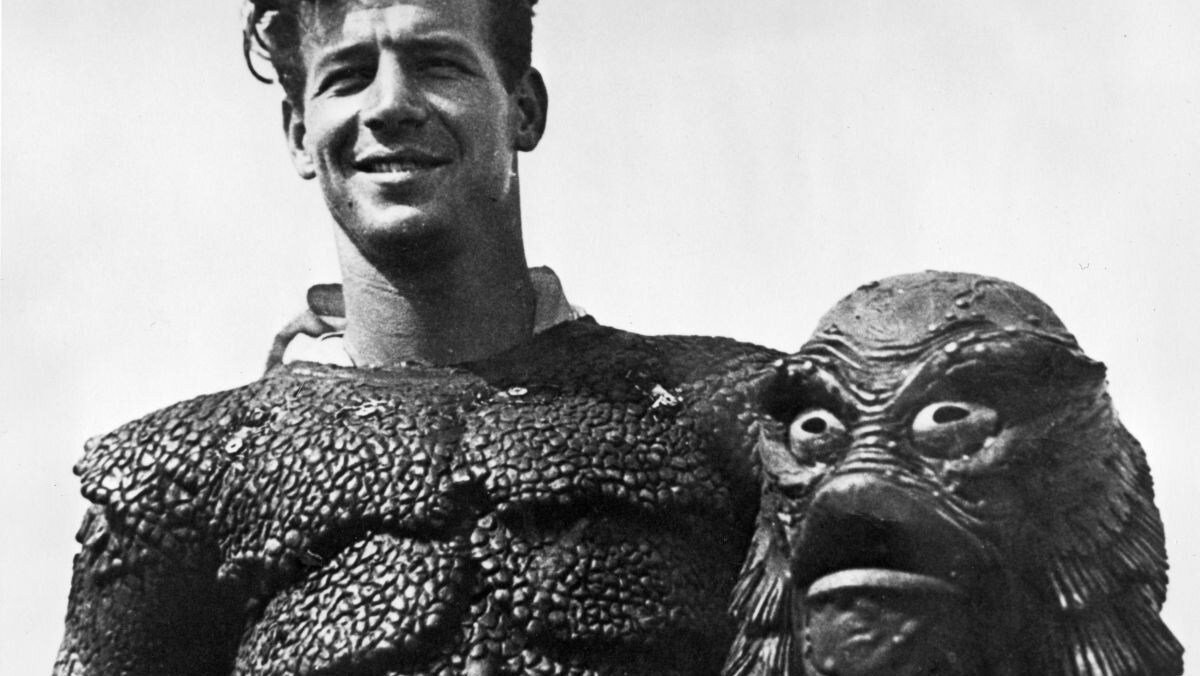
The female lead, Julie Adams, did nothing for my nascent sexuality. She was merely a scream machine in a revealing bathing suit. But her two scantily clad human male suitors got my engine revving almost as much as the creature from the Devonian age. Thus did a Greek boy come out to himself as same-sex attracted.
Strange but true! Why not?
Going on the original poster, the story’s main concern is sex. ’Centuries of passion pent up in his savage heart!’ In other words, Gill Man had blue balls and he was busting for some urgent interspecies shagging.
In this regard Gill Man is in the same boat as King Kong. Creature is a variant on the theme: male lust unleashed on a passive, usually startled, female recipient. Gill Man didn’t want to eat Kay, the lone female aboard the good ship Rita, he wanted to eat her out. So did her two bullish human suitors. The poor woman must have been drowning in a sea of testosterone.
This idea is best exemplified in the film’s most memorable sequence.
Idle Kay goes swimming in the lagoon while the men are busy with important matters elsewhere. What follows is a sequence that is riven with the contradictions and ambiguities that typify modern male/female relations.
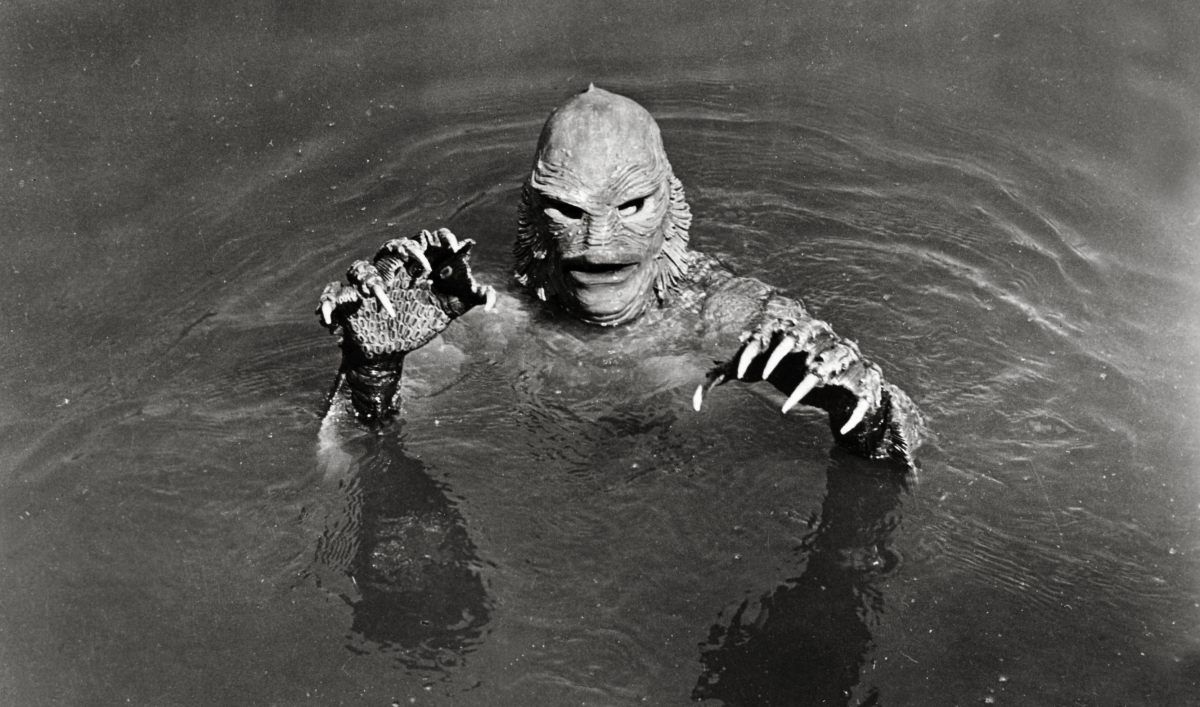
As Kay swims in the lake, she is blissfully unaware that keen eyes watch from among a clump of seaweed. Her deft underwater pirouettes and balletic manoeuvres entice Gill Man to emerges from his hiding place and get closer. As Kay treads water, he tentatively reaches out and tries to touch an enticement of paddling feet that almost sing out,
Toucha, toucha, toucha, touch me,
I wanna be dirty,
thrill me, chill me, fulfil me,
Creature of the night…*
Bobbing on the surface, Kay’s survival mechanism kicks in. Something is not right, but she doesn’t know what. Feelings of safety shattered, she swim back to the Rita, unaware her amphibian suitor follows at close range.
The shots of the creature watching Kay float ethereally on the surface of the water influenced Steven Spielberg when he directed the opening minutes of Jaws in 1975. Like John Williams’ iconic score for the latter-day blockbuster, the terror and eroticism in Creature is enhanced by Joseph Gershenson’s deft use of stock music, particularly in the astutely directed lagoon sequence.
It’s hardly original to state that Gill Man is a a proxy for fears about male sexuality. I’ll even risk vulgarity and say Gill Man is a stand-in for the male member waiting to rear its ugly head. I’m serious. All the men, human and otherwise, circle like worker bees around queen bee Kay, waiting their chance to mate. Some will be gentlemanly and others cavalier. Others will die trying. Working in tandem with this idea is the notion that base and ignoble instincts are to be vanquished before Man can approach Woman who, of course, possesses no independent sex drive of her own. She is fit only for being swept off her little feet, marriage and procreation.
Director Jack Arnold was a unique figure in Hollywood. In a short amount of time, he directed some of the most iconic 1950s sci-fi horror movies — It Came From Outer Space (1953), Tarantula (1955), and the greatest of them all, The Incredible Shrinking Man (1957) — and no matter how tawdry the titles, all are imprinted with thematic daring, strangeness and weird underlay of subtext.
That is why the four minute swim in the lagoon is so striking. With a complete absence of dialogue, it manages to say as much about urban woman’s presumption of safety as it does about male entitlement, courtship and predatory behaviour. Beautiful, eerie, and unsettling, it amounts to a sensuous ballet and a dance of death between a woman who thinks she is safe and an unseen assailant who may kiss or kill.
That in a nutshell is cinema’s interpenetration of sex and violence.
As created by Millicent Patrick, my boyfriend — I mean Gill Man — is a weird amalgam of fish, Steve Reeves and Ken Doll. For a creature disporting rampant sexual appetites, there is a disturbing absence of genitalia. Gill Man is neutered — of no use to anyone who may want to bump and grind with him. Thankfully, Guillermo del Toro rectifies the situation in The Shape of Water (2017) by giving his creature genitals that emerge at the pivotal moment from a protective encasement. His female consort was tickled pink. So was I.
* Rocky Horror Picture Show
Dmetri Kakmi is the author of The Dictionary of a Gadfly (as The Sozzled Scribbler), The Door and Other Uncanny Tales, Mother Land, and When We Were Young (as editor). His gothic fantasy, The Woman in the Well, will be published in March 2025. He is working on a psychological crime novel called The Perfect Room.


 The Drunken Odyssey
Leave a comment