
with Dmetri Kakmi
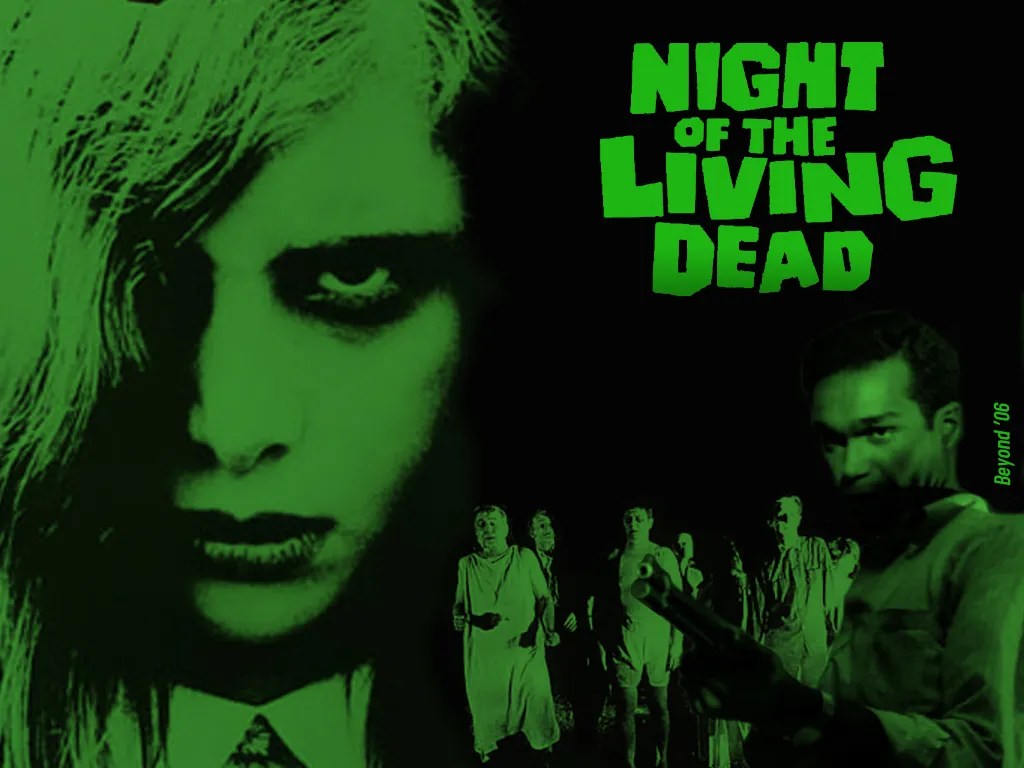
Night of the Living Dead
USA 1968
Director: George Romero
Cast: Duane Jones, Judith O’Dea, Marilyn Eastman, naked undead hordes
Your morbid correspondent first saw this milestone in 1969, a year after its initial release. I was eight years old and growing up in Turkey. The film was dubbed in Turkish. Consequently, I thought it was a product of our dubious motion picture industry. I was disabused of this illusion when I saw it a second time a little more than a decade later on Australian television and realised it was American.
Amid the terror of that first viewing, my brain noted the film’s underlying allusive nature. This wasn’t merely a horror movie about zombies. It was political commentary. Given that I knew nothing about America, I applied what I saw on screen to the particular circumstances of my country. Namely, the persecution of ethnic Greeks living in Turkey in the early to mid twentieth century. In basic terms, Greeks were being eradicated from their ancient homeland by nationalists and Islamists making way for an ‘ethnically pure’ Turkish Republic, an illusory beast.
For skinny little me, the murderous zombies outside the farmhouse represented Turks. The terrified people trapped inside and fighting for their lives were Greeks. The film’s coda left me in no doubt that our days were numbered.
It was only when I saw the film a second time as a young adult that I realised its relevance to the USA.

What makes Night of the Living Dead effective? The ending.
Night of Living Dead concludes not with triumph, but with a highly ironic tragedy that redefines the horror genre and critiques the social and political tensions of the time. The final moments, where Ben, a black man and the sole survivor of the zombie apocalypse, is mistaken for one of the undead and shot by a posse, serve as a powerful commentary on race, and much else, in America.
Ben is the most grounded and resourceful character in the film. He takes charge, safe-guards the house, and attempts to maintain order among a group of increasingly panicked white survivors. His leadership contrasts sharply with the foolish behaviour and fear exhibited by others. Ben’s survival through the night affirms his competence and resilience. However, the ending turns this notion on its head.
The arrival of the armed posse, composed of white men casually dispatching zombies with rifles, initially suggests salvation. Yet, their approach is disturbingly recreational. They could be hunting rabbits or deer. The grainy documentary-style cinematography evokes real footage of racial violence and civil unrest from the 1960s, particularly the imagery associated with lynchings, mobs and police brutality—events Romero and his script writer Russo would have seen on television.
When Ben is shot, the act is not just a horrible mistake; it is a symbolic execution. The fact that no one checks to see if he is alive, and that his body is treated with the same disregard as the zombies, underscores the dehumanisation.
Romero’s decision to cast Duane Jones in the lead was groundbreaking. Even though Romero claims it was not intended as a racial statement, the implications are unavoidable. In the context of 1968 America, marked by the assassinations of Martin Luther King Jr. and civil rights protests, the film’s climax resonates as a bleak reflection of injustice in the US.
I am not black or American. But I am gay and I know something about persecution. That’s why for me the ending and particularly Ben’s demise is laden with significant meaning.
Despite his heroism and intelligence, Ben is not seen as human. He is killed and discarded like rubbish. His death mirrors the real-world violence faced by black Americans and other ethnic and sexual minorities. The image of his body being burned on a pyre is perhaps the most distressing image in the film. Even for non Americans it evokes images of persecution and violence, symbolising how the lives of those on the periphery are often devalued and dehumanised.
Gay men watching the final moments of this film in 2025 will be reminded of the 1998 murder of gay teen Matthew Shepard, in Wyoming. He was severely bashed by two assailants, strung up like a scarecrow in a field and left to die in the freezing cold. The callous disregard shown towards Shepard is not a thing of the past. Violence towards homosexuals has increased in the last decade for the first time since the 1990s. The situation is no better for ethnic minorities.
The end of Night of the Living Dead rewrites the conventions of horror cinema to that point and prophesies a bleak future. Traditionally, survivors are rewarded with safety or catharsis. Romero denies this comfort, offering a nihilistic vision where survival is arbitrary and justice absent. This is, in a sense, an existentialist horror movie that makes full use of the term absurdism to bring home its message. The final horrific montage blurs the line between human and monster, suggesting that the true horror lies not with the undead, but with the living.
This is why Romero’s first outing continues to be influential and why it is the granddaddy of horror movies.
Dmetri Kakmi is the author of The Woman in the Well, The Door and Other Uncanny Tales, Mother Land, and When We Were Young (as editor). He is working on a psychological crime novel called The Perfect Room.

 The Drunken Odyssey
Leave a comment