
with Dmetri Kakmi
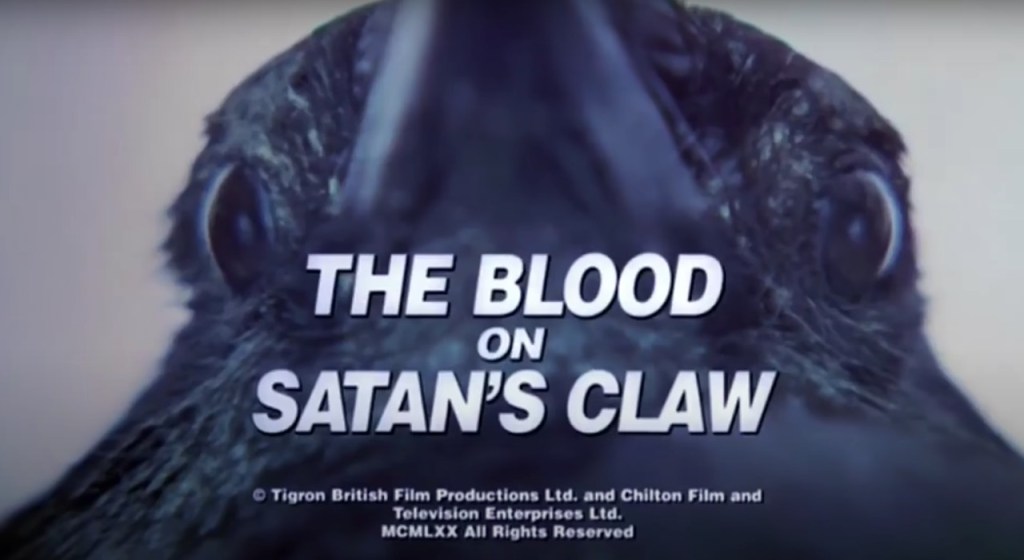
The Blood on Satan’s Claw
England 1971
Director: Piers Haggard
Cast: Patrick Wymark, Linda Hayden, Barry Andrews, Michele Dotrice, the Beast
My first encounter with this low-budget gem was on late-night television. Bad print, censored and strewn with ads, it left little to no impression. Years later I saw the beautifully restored version on a big screen and was thoroughly impressed. As folk horror goes, it’s on a level with the best, while raising intriguing questions about depiction and the function of art.
Set in seventeenth century England, The Blood on Satan’s Claw is a disquieting tale that says as much about the time in which it is set as it does about 1960s counterculture and the sexual revolution. The story begins on a macabre note with the discovery of a grotesquely deformed skull in a ploughed field—the chthonic erupting into daylight—and it gets progressively disturbing as it goes on. Soon “possessed” children are swept up in a frenzy of disorderly behaviour, including rape and murder, leaving confused adults fighting to maintain order.
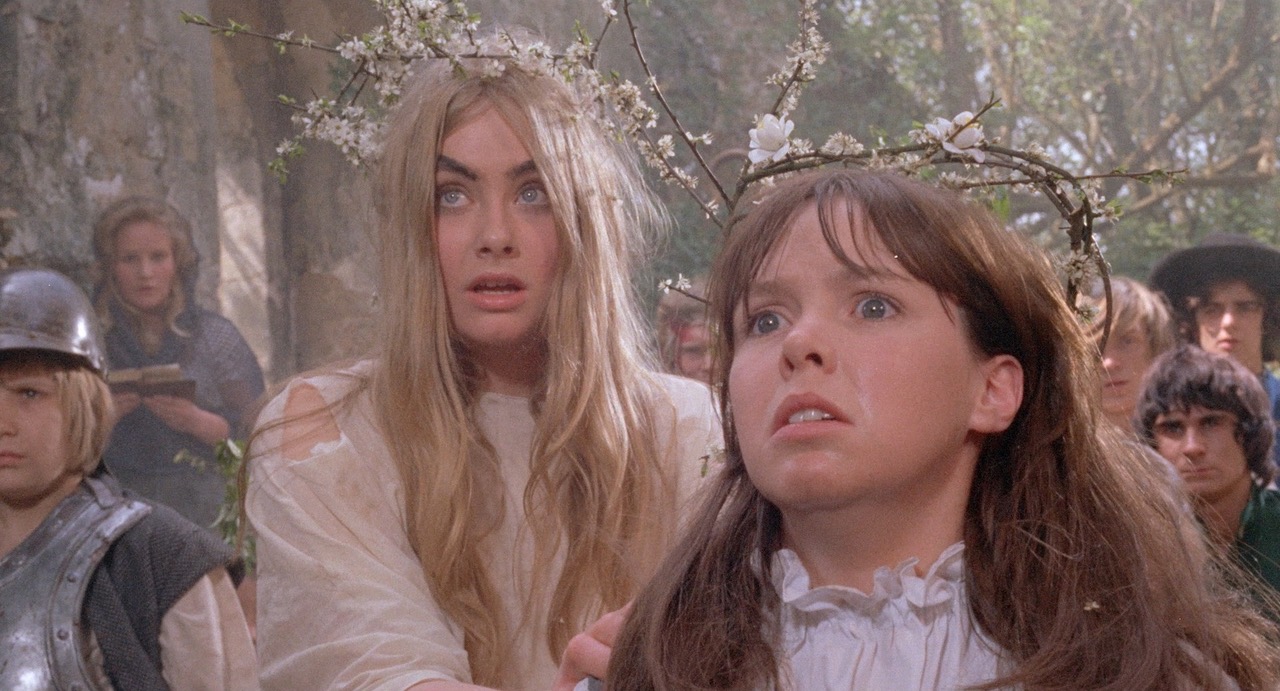
Juxtaposition of ideas is everything. In a carefully articulated narrative, to see one thing is to be put in mind of another. Thus, to witness wild teenagers marauding through a medieval forest, like frenzied Bacchantes, is to be put in mind of Flower-Power hippies dancing in San Francisco’s Golden Gate Park; to see Linda Hayden as Angel Blake, the sabbath queen, commanding an army of delirious teens is to think of 1960s cult leaders ruling over an army of murderous disciples.
At heart this is a carnal film. Not sexy, though sex plays a big part, but carnality of a twisted type. The kind of sex and libidinousness that is dangerous when it gets out of hand. Sex that spreads like disease and leads to sadism, corruption and bloodshed. This is nowhere better exemplified than in two now (in)famous sequence. The first is when Angel Blake tries to seduce the curate Reverend Fallowfield, circling him like a bird of prey in his own domain. The second is when a group of boys to lure young Cathy to a ruined church in the forest and gang rape her.
In the first, a woman uses her sexuality to lure a man to his doom. A misogynist trope is turned on its head by unashamedly depicting a woman in full control of the power she wields over man. The second instance is the flip side of the coin: male strength against female vulnerability. The things men can do when law and order breaks down. Yet far from exploiting Cathy’s ordeal for pleasure, the rape sequence shows the full horror of what it means to be rendered powerless and violated.
These two sequences leave the viewer in no doubt that rape is barbarous and sex a battleground. The beast enters via the most vulnerable and accessible point, the sexual urge, and corrupts and debases its purest expression; a Judaeo-Christian notion if ever there was one. In true folk horror sex and the body are elemental, joyous, unbounded, with an edge that spirals back to the chthonic. See, for example, the celebratory and frankly sexual nudity in Robin Redbreast (1970) and The Wicker Man (1973) and the darkness to which it can lead.
The Blood on Satan’s Claw puts me in mind of two other films that have a similar disquieting effect: Straw Dogs (1971) and The Wicker Man (1973). In the first Susan George is assaulted in an agonising sequence that is highly ambiguous; in the second, Britt Ekland performs a naked dance that gives a whole new meaning to pagan sexuality. The point is not to exploit (though I’d argue every entertainment is simultaneously an act of exploitation), but to make viewers examine themselves before an ambivalent universe. We are also made aware that art is not meant to mollify. It’s meant to disturb.
The Blood on Satan’s Claw fulfills all the criteria admirably.
Dmetri Kakmi is the author of The Woman in the Well, The Door and Other Uncanny Tales, Mother Land, and When We Were Young (as editor). His essays and short stories appear in anthologies. He is working on a psychological crime novel called The Perfect Room.

 The Drunken Odyssey
Leave a comment