
with Dmetri Kakmi
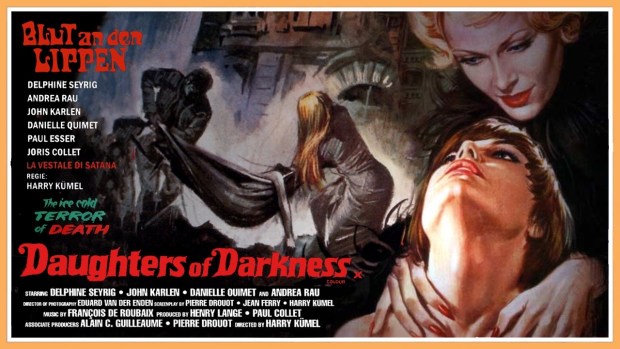
Daughters of Darkness
Belgium 1971
Director: Harry Kümel
Cast: Delphine Seyrig, Andrea Rau, John Karlen, Danielle Ouimet, Fons Rademakers
Be still my beating heart. We now speak in reverential tones about one of my favourite horror movies and the best vampire movie in existence.
I speak about the swoon worthy, deliciously perverse and bloody sexy Daughters of Darkness, starring the exquisite Delphine Seyrig at her honey-tongued best. High claims, I know. But, as the sage on the mount says, once seen, never forgotten. Seyrig is so good, she even managed to encoffin her friend, Catherine Deneuve, when the French icon played a stylish but rather stiff bloodsucker in The Hunger (1983).
If you don’t believe me read the plot summary on IMDB. ‘A gorgeous but mystifying woman … and her sultry aide seduce a newly-wed couple at a swanky French hotel. A hysteria of violence and depravity begins.’ (It’s a Belgian hotel, not French. But who cares when depravity is on the menu?)
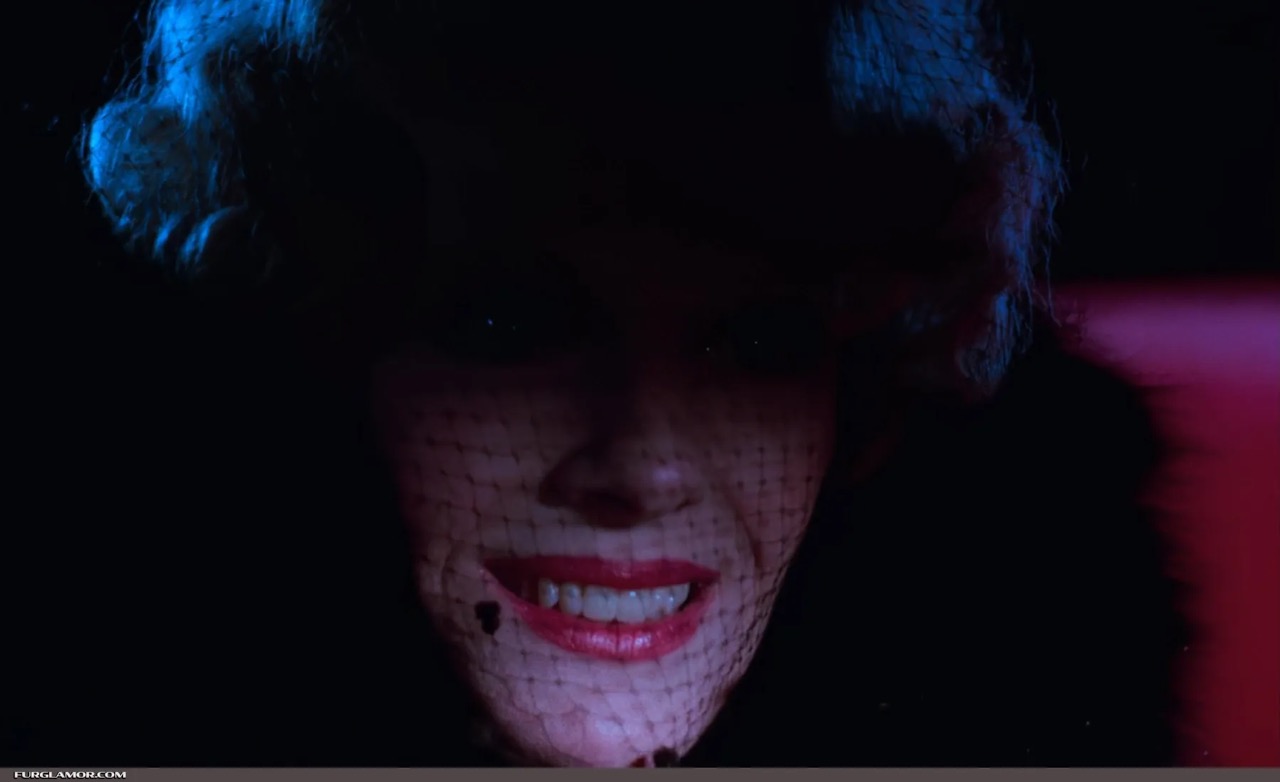
‘Mystifying’, ’sultry,’ ’hysteria’, ‘violence’. Bring it on, baby. Okay, ‘sultry’ is my addition. But you’d have to be (un)dead not to find Andrea Rau’s Ilona, with her bruised red lips and hooded eyes, sultry—in a melancholy, doomed sort of way, of course, as all ill-fated vampires must be. Furthermore, Ilona will do anything to gain the favour of her beautiful but cruel mistress, Countess Elizabeth Bathory, who favours the fair sex with the same vigour she puts into despising the masculine.
The aforementioned newly weds comprise of insipid Stefan and his equally bland paramour Valerie. What the Countess sees in Valerie is beyond me. Whatever it is, she wants it. And what the Countess wants she gets. First, Stefan must be eliminated. The betrayal is etched on poor Ilona’s gorgeous Louise Brooks countenance. But there is nothing the poor whelp can do, except aid and abet her highly manicured monstrous mistress, who is intent on imitating Marlene Dietrich circa 1932 in every scene.
Admittedly, if I was Valerie I’d choose the Countess over Stefan, too. Judging from his choice of clothing and accessories, he is obviously gay, for heaven’s sake. Alarm bells must have rung for the bourgeois princess when her new hubby takes her to meet ‘Mother’ and the feared matriarch turns out to be an old queen decked out like the Duchess of Alba ensconced in a hot house, like a deadly Venue fly trap. Stefan was obviously a kept boy, straining homo-bonds. Though it must be said seeing Fons Rademakers as Mother is a camp delight for the ages. It’s truly inspired. We haven’t witness such an audacious sex-swapping cameo since Elspeth Dudgeon portrayed Sir Roderick Femm in The Old Dark House.
Filmmakers ought to be praised for telling stories about people outside their own purview. Such transhumanist tales as the Wachowskis’ Bound and William Friedkin’s Cruising, for instance, show us what the empathic imagination can do without the corroboration of direct experience.
Director Harry Kũmel falls squarely into this category. Far as I know he is not a daughter of Sappho. Yet his ability to imaginatively project outside the confines of his own background produced a lesbian cult classic that is yet to be equalled.
His small body of work is characterised by a strong visual style and he often deals with intense subject matter, with altered states of existence and characters drawn from society’s margins. A crossdressing femme fatale in Monsieur Hawarden (1968), for instance, and occultists in the unearthly Malpertius (1972). Kũmel describes himself as a formalist who despises naturalism. This is abundantly obvious in Daughters of Darkness. The plot falls apart under scrutiny; it exists purely in a highly stylised, phantasmal realm outside everyday reality. In describing it as ‘a fairy tale for full-grown adults,’ Kũmel acknowledges that the film is self-consciously fabricated. When watching a high gothic fever dream, we do not expect the intrusion of realism and logic.
It’s obvious why queers of both sexes flock to this panegyric 50 years after its release. Lesbians go for girl power and gay guys go for haute couture and insouciance. At base Daughters of Darkness is a hymn to fading European decadence. That’s why the vast Ostend hotel, as anachronistic as the Countess, is empty for the winter and awaits the indulgence of only four well-to-do guests who float in a rarefied air of ennui generated exclusively for their doomed pleasures.
I secured a suite. Have you?
Dmetri Kakmi is the author of The Woman in the Well, The Door and Other Uncanny Tales, Mother Land, and When We Were Young (as editor). His essays and short stories appear in anthologies. He is working on a crime novel called The Perfect Room.
Dmetri Kakmi is the author of The Woman in the Well, The Door and Other Uncanny Tales, Mother Land, and When We Were Young (as editor). His essays and short stories appear in anthologies. He is working on a psychological crime novel called The Perfect Room.

 The Drunken Odyssey
Leave a comment