
Few things can get into my mind to the point where I forget myself, and all of them are different songs that keep me up at night. Luckily, I don’t have to deal with malevolent psychic presences laying eggs in my subconscious that allow back-door access to all of thoughts, dreams, fears, and memories as there’s no way I can fight against that. But fighting against that presence is what guides us through the final arc of Grant Morrison, Ivan Reis, Chris Weston, John Stokes, Mark Pennington, and Ray Kryssing’s The Invisibles: Kissing Mister Quimper.
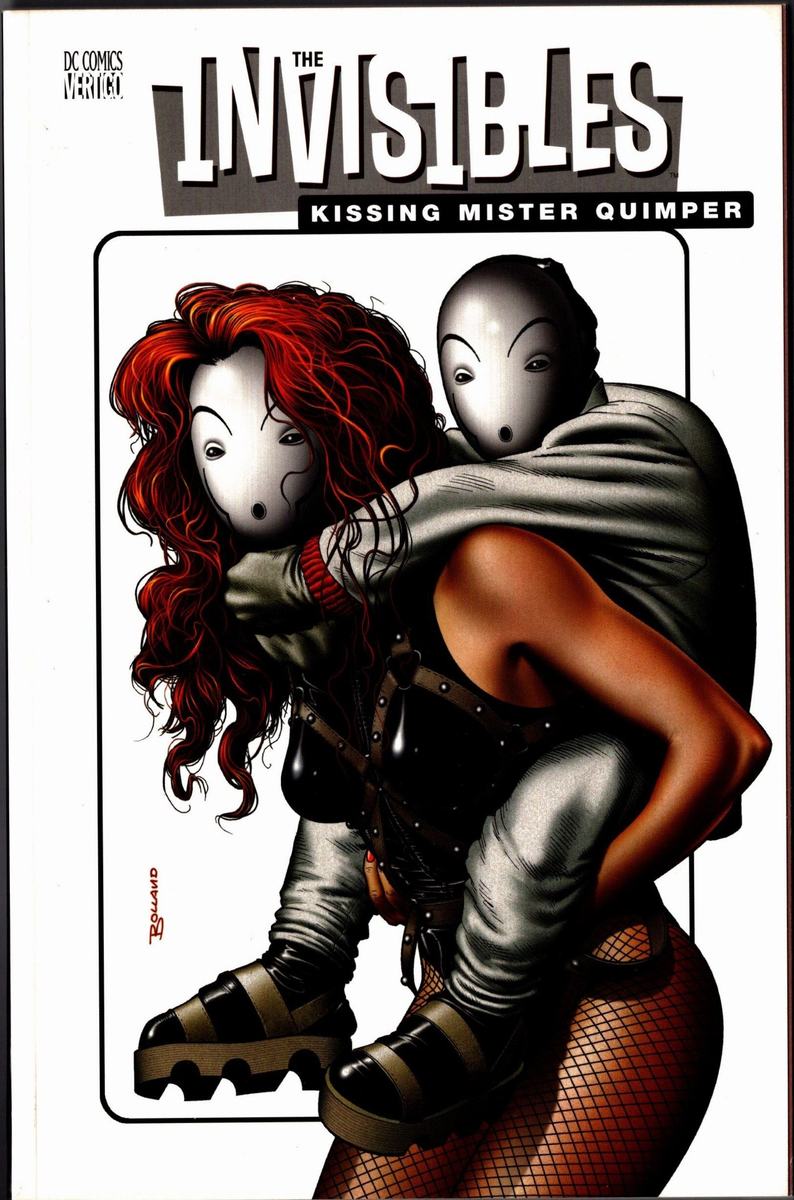
Can a comic have a sequel series inside it’s own series? Morrison believes so and no one can stop them as we enter into the next phase of “Black Science” and this cell of the Invisibles returning to Dulce to see what else they can find hiding in this military base. But to get back they need to plan—the enemy has machines that can turn you paranoid, entities that can damage you at the cellular level just by being in the same room, and Mister Quimper back from the dead. There is, though, a hand the Invisibles here always seem to hide. While they’re under the effects of the aforementioned horrors, they’re all still planning something in the background. Quimper has a cell of himself in Robin’s brain, but she’s trapped him in a false memory. The paranoia machine has been stolen and repurposed. And the outer-world entity that can erupt all of your blood from inside your skin is busy talking with a petulant British teenager.
There exists between these two volumes a chasm—the divide between the kinds of genres The Invisibles as a story is exploring. When we first meet Dane in Liverpool, there’s a fantastical element to his story. He’s a shit kid who may become one of the greatest sorcerers of his age and we learn what magic represents in this world through the land it comes from. By contrast, when we jump into New York City, we have a tonal and genre shift. There are still these magical elements, but with things like time travel, secret military bases underground harboring alien presences, paranoia machines, we’re beginning to step firmly into the realm of science-fiction. But the best trick Morrison plays through these two volumes is how slowly and deliberately this genre shift occurs. We still see elements of a distinctly European urban fantasy they begin with—the magic never truly goes away—but it’s now supplemented by the machinery and conspiracy at the heart of American science-fiction.
While Kissing Mister Quimper is the last volume of this arc, it’s not the end of the series. Even if the final issue does give us the feeling of this all being the end as some characters are being sent backwards and forwards in time while others are contemplating leaving the organization all together, there’s still the promise of the new millennium just on the horizon and a single panel of Dane making promises in the future from way back in the second volume.
Get excited. Get counting.
Drew Barth (Episode 331, 485, 510, 651, & 674) resides in Winter Park, FL. He received his MFA from the University of Central Florida.


Leave a Reply