
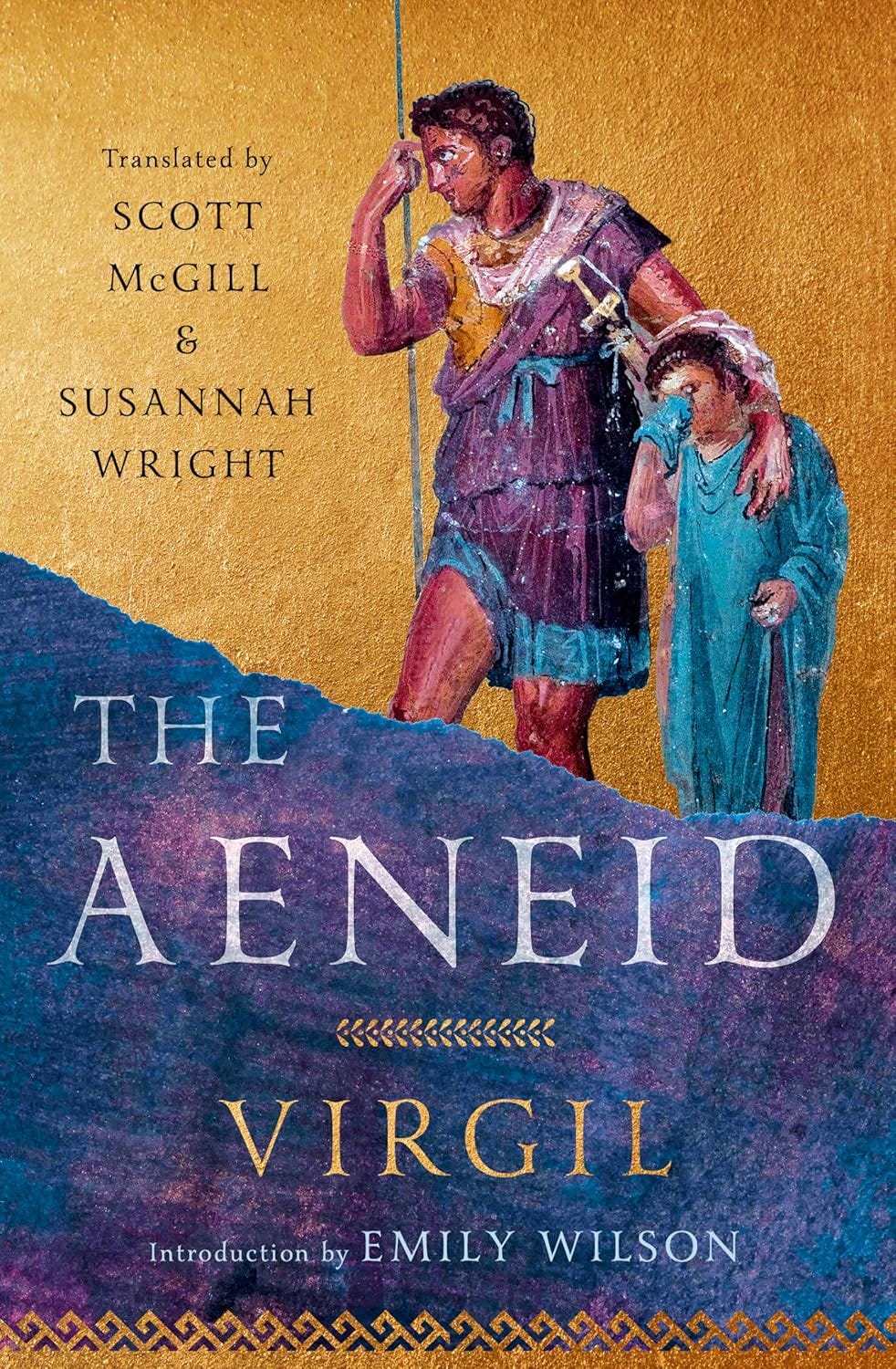
Scott McGill and Susannah Wright’s translation of Virgil’s The Aeneid is a nail-biting, surprisingly readable version of a Latin epic. The Aeneid’s twelve sections enact the tribulations of Aeneas and his soldiers in the founding of Rome, from their flight from fallen Troy to detours in the underworld to starting a new civilization on a foreign shore.
Scott McGill and Susannah Wright’s translation seems breezy, yet classical. One example is the first appearance of Dido, the queen of Carthage, who “walked in joy among her people” and “appeared by urging on the work that would create her kingdom.” This description emphasizes Dido’s spirit and her importance to Aeneas and creates a cruel irony for the audience when he abandons her. Dido is described as a beloved leader, making the audience believe that someone so pure might be untouchable or should be long-lasting as a symbol for Aeneas’s future. However, Aeneas ultimately leaves her to become that same type of leader. For her, love was so deep that its end caused the end of her life. For him, she was merely inspiration for good things to come.
In McGill and Wright’s style, Virgil’s settings, such as the underworld, feel evocative. Book 6 “Shades of Past and Future” perfectly exemplifies this. Aeneas goes to speak to Underworld prophet Sibyl. There is a “massive cave, to which there lead a hundred entrances, a hundred mouths that echo with a hundred rushing voices—the Sibyl’s answers.” Such descriptions give each setting its own blend of darkness, danger, and mystery. There is similarly expansive impressionistic detail given to a different setting in Book 7 “Fury in Italy.” Here, Aeneas visits King Latinus, whose kingdom contains important structures described not merely by looks, but rather by their purpose and symbolism to the people. In the royal palace, “kings received their scepters and their rods,” but also, “began their reigns beneath good omens.” This is not pure showing, but instead seems to show history as a feeling.
Compared to modern narratives, the plot advances slowly. At first, the long exposition seems daunting as various characters, settings, and battles are introduced without the strong lurch of narrative urgency.
However, as our hero advances in his journey, it becomes clearer that the pace is a necessity to make each section and character distinct enough to remember in the role they eventually will play. Through this slow narration style it becomes easy to see how, in the grand scheme of things, there are no “filler chapters” and every character plays their part. Juno’s anger determines parts of Aeneas’ fate and leads him on his journey, his mother Venus’ assistance helps him fulfill his destiny, his love for Juno reminds him of his mission, and his battle with Turnus is a culmination of everything his fate has led him up to. His eventual victory was achieved and feels all the sweeter to read about considering every painful drawback.
All in all, Scott McGill and Susannah Wright take Virgil’s epic The Aeneid and turn it into an epic translation that keeps the reader on their toes without confusing them. Through Troy to the Underworld to new beginnings, this translation represents quite a journey.

When not writing poetry, Sophia Ferrara (Episodes 682, 702, 710, and 711) studies dystopian literature in the English program at the University of Central Florida.


Leave a comment